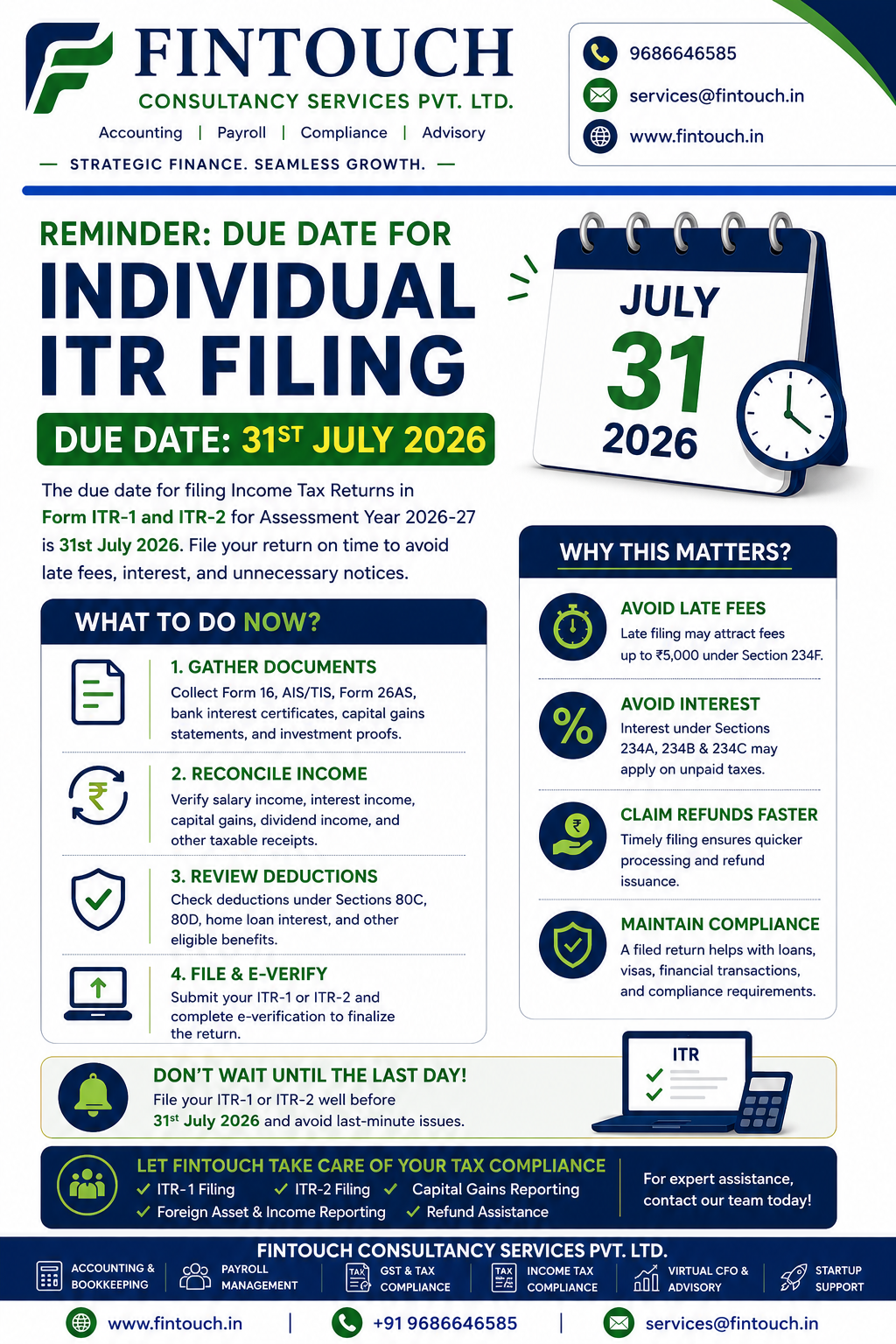
ITR filing for Assessment Year 2026-27 (Financial Year 2025-26) is officially open. The Income Tax Department has already enabled ITR-1 (Sahaj), ITR-2, and ITR-4 (Sugam) on the e-filing portal, with more forms expected in the coming weeks.
But before you file — or before you ask your CA to file — it is important to know what has changed from last year. Some of these updates directly affect which form you should be filing and what documents you need to keep ready.
Here is everything you need to know.
Forms Currently Available on the E-Filing Portal
As of June 2026, the following ITR forms are live at incometax.gov.in for AY 2026-27:
| Form | Who Should File | Status |
|---|---|---|
| ITR-1 (Sahaj) | Salaried individuals, pensioners — income up to ₹50 lakh | ✅ Live |
| ITR-2 | Capital gains, multiple house properties, foreign income | ✅ Live |
| ITR-4 (Sugam) | Presumptive income — sections 44AD, 44ADA, 44AE | ✅ Live |
| ITR-3 | Business or professional income | ⏳ Coming Soon |
| ITR-5 | Firms, LLPs, AOPs | ⏳ Coming Soon |
| ITR-6 | Companies | ⏳ Coming Soon |
| ITR-7 | Trusts, institutions | ⏳ Coming Soon |
Important Clarification Before We Begin
Even though the new Income Tax Act, 2025 came into force on 1 April 2026, your AY 2026-27 return covers income earned during FY 2025-26 — which falls under the Income Tax Act, 1961. CBDT has confirmed this. Deductions under sections 80C, 80D, 24(b), 80TTA, and the rebate under section 87A continue to apply as usual. Do not let the new Act cause any confusion while filing this year.
What Has Changed in Each Form — AY 2026-27 vs AY 2025-26
ITR-1 (Sahaj) — The Biggest Change This Year
Who files this: Salaried individuals, pensioners, and those with interest or rental income — total income up to ₹50 lakh.
The most significant change in AY 2026-27 is for ITR-1 filers. In AY 2025-26, this form could only be used by taxpayers with income from one house property. From this year, ITR-1 now accommodates income from up to two house properties. This is a major relief — many taxpayers who were unnecessarily filing the more complex ITR-2 solely because of a second property can now switch back to the simpler ITR-1.
Other changes in ITR-1:
- Tenant details now mandatory: If you earn rental income, you must now disclose the tenant’s name along with their PAN or Aadhaar number. This was not required in AY 2025-26.
- Secondary contact details added: The form now captures a secondary mobile number, secondary email address, and an alternate address.
- Representative assessee filing simplified: Filing on behalf of a deceased person or minor is now easier, with reduced disclosure requirements.
- Section 89A removed: If you claim relief on income from a foreign retirement account, you can no longer do so through ITR-1. You will need to file ITR-2 or ITR-3 for this purpose.
ITR-2 — Simpler Capital Gains Reporting
Who files this: Individuals and HUFs with capital gains from shares, mutual funds or property; income from more than one house property; or foreign assets and income.
The most notable change in ITR-2 this year is the simplification of capital gains reporting. In AY 2025-26, taxpayers had to split their capital gains transactions as before and after 23 July 2024, because the tax rates changed on that date. Since those old rates (15% STCG and 10% LTCG) no longer apply for FY 2025-26, the corresponding fields have been entirely removed from the AY 2026-27 form.
Updated capital gains rates now applicable:
- Short-term capital gains on equity (Section 111A): 20%
- Long-term capital gains on equity (Section 112A): 12.5%
Other changes in ITR-2:
- The July 23 date-split requirement for capital gains is gone entirely.
- Secondary mobile, email and address fields now mandatory.
- Tenant’s PAN or Aadhaar now required for rental income.
- Section 89A field removed — foreign retirement account claims must use ITR-3 going forward.
If you sold equity mutual funds or listed shares during FY 2025-26, the capital gains schedule is considerably simpler this year. Keep your Consolidated Account Statement (CAS) from NSDL or CDSL and your broker’s capital gains statement ready before filing.
ITR-4 (Sugam) — More Disclosure Required
Who files this: Individuals, HUFs and firms (other than LLPs) opting for presumptive taxation under sections 44AD (business), 44ADA (professionals) or 44AE (transport operators) — income up to ₹50 lakh.
While ITR-1 and ITR-2 have largely become simpler, ITR-4 requires more from filers this year.
Changes in ITR-4:
- Investment and bank balance disclosure is now mandatory: This is a new requirement not present in AY 2025-26. Presumptive taxpayers must disclose investment details and bank balances in the return. Keep your FD certificates, mutual fund statements, and latest bank balance details ready.
- Two house properties now permitted: Similar to ITR-1, ITR-4 now accommodates up to two house properties.
- Tenant’s PAN or Aadhaar now required for rental income.
- Secondary contact details now mandatory.
- Section 89A field removed.
Changes Common Across All Forms
Regardless of which ITR form you file, the following changes apply uniformly in AY 2026-27:
- Secondary contact details are mandatory — secondary mobile number, email address, and alternate address are now required fields, not optional.
- Tenant’s PAN or Aadhaar is required for any rental income reported in house property schedule.
- New tax regime selection is clearer — the process for opting in or out of the new tax regime has been streamlined, reducing the confusion around Form 10-IEA that many taxpayers faced last year.
- Representative assessee filing is simplified across all forms for filing on behalf of deceased persons, minors, or legally incapacitated individuals.
Key Deadlines for AY 2026-27
| Compliance | Due Date |
|---|---|
| Form 16 from employer | 15 June 2026 |
| ITR filing — salaried, individuals, HUF (non-audit) | 31 July 2026 |
| ITR filing — business/profession (non-audit) | 31 August 2026 |
| ITR filing — audit cases | 31 October 2026 |
| E-verification after filing | Within 30 days of filing |
| Belated return | 31 December 2026 |
Critical reminder: An ITR filed but not e-verified within 30 days of submission is treated as a defective return — legally the same as never having filed. Always complete e-verification immediately after submitting your return using Aadhaar OTP, net banking, or Demat account.
Quick Checklist Before You File
For all taxpayers:
- PAN and Aadhaar (must be linked)
- AIS and Form 26AS
- Bank account details for refund
- Secondary mobile and email
- Tenant’s PAN or Aadhaar (if applicable)
For salaried individuals:
- Form 16 (available from employer after 15 June)
- Bank interest certificates
- Home loan interest certificate
- 80C investment proofs — PPF, ELSS, LIC, NSC
For capital gains filers:
- CAS from NSDL or CDSL for mutual funds
- Capital gains statement from broker
- Property sale documents if applicable
For ITR-4 filers:
- Turnover or receipts summary
- Business bank statements
- Investment details and bank balances (new this year)
Need Help Filing Your Return?
At Fintouch Consultancy Services Pvt. Ltd., we manage ITR filings for salaried individuals, business owners, professionals, companies and trusts. We ensure the correct form is selected, all new disclosures are captured, and your return is filed and verified well before the deadline — without any last-minute stress.
Get in touch with us today and let us handle your filing for AY 2026-27.
Disclaimer: This article is for general informational purposes only and does not constitute professional tax advice. Please consult a qualified tax professional for advice specific to your situation.