Stacked gold coins with wooden blocks spelling 'TAX' on a green backdrop.

Proposed GST Reform on Input Tax Credit (ITC): Major Relief Expected for Genuine Taxpayers

Introduction

A significant reform under the Goods and Services Tax (GST) framework is reportedly under consideration that could provide substantial relief to honest and compliant taxpayers. The GST Council’s Law Committee has approved a proposal aimed at protecting genuine recipients from losing their Input Tax Credit (ITC) merely because a supplier fails to deposit GST with the Government.

While this development has generated considerable interest among businesses, it is important to note that the proposal is not yet law. It will become effective only after approval by the GST Council and the subsequent amendment of the CGST Act.

Existing Legal Position

Section 16(2)(c) of the Central Goods and Services Tax (CGST) Act currently provides that a recipient is eligible to claim ITC only if the tax charged on the supply has actually been paid to the Government by the supplier.

As a result, tax authorities have often denied ITC to recipients in cases where:

  • Goods or services were genuinely received;
  • A valid tax invoice was available;
  • Payment, including GST, was made to the supplier; and
  • The supplier subsequently failed to remit the GST collected.

This provision has led to numerous disputes, demands, and litigation involving bona fide taxpayers who had no control over the supplier’s compliance behaviour.

Challenges Faced by Businesses

The current framework places a significant compliance burden on recipients, requiring them to continuously monitor vendor compliance.

Many businesses have faced situations where:

  • ITC was reversed despite genuine transactions;
  • Additional tax liabilities were imposed along with interest and penalties;
  • Working capital was adversely impacted;
  • Considerable resources were spent on defending litigation.

The issue has been one of the most debated topics under GST since the introduction of the indirect tax regime.

What the Proposed Reform Seeks to Achieve

According to reports, the proposed amendment seeks to ensure that genuine recipients are not penalized for supplier defaults beyond their control.

If approved, a taxpayer who:

  • Has received the goods or services;
  • Possesses a valid tax invoice;
  • Has paid the supplier, including GST;
  • Has acted in good faith and exercised reasonable diligence;

may continue to retain the ITC even if the supplier fails to deposit the GST with the Government.

In such cases, the primary responsibility for tax recovery would shift to the defaulting supplier rather than the recipient.

Potential Impact on Businesses

The proposed reform could have far-reaching benefits across industries.

1. Protection for Genuine Taxpayers

Businesses that have fulfilled all statutory obligations would no longer be exposed to tax demands solely because of supplier non-compliance.

2. Improved Cash Flow

Avoiding ITC reversals can significantly reduce working capital pressures and improve liquidity.

3. Reduction in Litigation

A large number of disputes currently pending before tax authorities and appellate forums arise from supplier-default-related ITC issues. The amendment could substantially reduce such litigation.

4. Greater Business Certainty

Businesses would gain greater confidence while claiming eligible credits and planning their tax positions.

5. Strengthening the GST Framework

The proposal aligns with the fundamental principle that taxes should not be recovered from a person who has already paid the tax component as part of a genuine commercial transaction.

Important Considerations

Despite the positive development, businesses should remember that the proposal is not yet part of the law.

Until the amendment is formally enacted, taxpayers should continue to follow existing compliance requirements and maintain strong internal controls.

Recommended practices include:

  • Regular reconciliation of GSTR-2B with purchase records;
  • Verification of supplier GST compliance status;
  • Periodic vendor due diligence and compliance reviews;
  • Timely follow-up with non-compliant suppliers;
  • Maintenance of complete documentation supporting ITC claims, including invoices, payment proofs, contracts, purchase orders, and delivery records.

Our Perspective

The proposed amendment is one of the most taxpayer-friendly GST reforms under consideration in recent years. It seeks to strike a fair balance between protecting government revenue and safeguarding honest businesses that have acted in good faith.

By shifting the focus of recovery proceedings to defaulting suppliers, the proposal has the potential to reduce unnecessary hardship for compliant taxpayers while strengthening trust in the GST ecosystem.

Conclusion

If approved by the GST Council and enacted through legislative amendments, this reform could mark a significant shift in the treatment of Input Tax Credit disputes under GST. It would provide much-needed certainty to businesses and reinforce the principle that genuine taxpayers should not be penalized for defaults committed by others.

Fintouch Consultancy Services Pvt. Ltd. will continue to closely monitor developments and keep businesses informed about all significant GST and taxation updates.

Disclaimer: The information contained in this article is based on publicly available reports regarding a proposed amendment under GST. The proposal has not yet been approved by the GST Council nor enacted into law. Readers are advised to seek professional advice before making any business or tax decisions based on the information discussed herein.


MCA Extends Companies Compliance Facilitation Scheme (CCFS-2026) Till 31 August 2026

MCA Provides Additional Time for Pending Statutory Filings

The Ministry of Corporate Affairs (MCA), through General Circular No. 03/2026 dated 08 July 2026, has extended the validity of the Companies Compliance Facilitation Scheme, 2026 (CCFS-2026) from 15 July 2026 to 31 August 2026.

The extension has been granted considering the ongoing capacity enhancement and restoration activities at MCA’s data center following the fire incident reported on 05 June 2026.

What is CCFS-2026?

The Companies Compliance Facilitation Scheme (CCFS-2026) was introduced by MCA to provide companies and stakeholders an opportunity to complete pending statutory filings and regularize compliance requirements within a specified period.

The scheme aims to reduce compliance burdens and facilitate smooth filing of overdue documents without unnecessary procedural difficulties.

Key Highlights of the Extension

  • Scheme: Companies Compliance Facilitation Scheme, 2026 (CCFS-2026)
  • Original Validity: Up to 15 July 2026
  • Extended Validity: Up to 31 August 2026
  • Circular Number: General Circular No. 03/2026
  • Date of Circular: 08 July 2026
  • Issued By: Ministry of Corporate Affairs (MCA)

Why Was the Extension Granted?

MCA has cited the capacity enhancement and restoration activities being undertaken at its data center due to the fire incident that occurred on 05 June 2026. To ensure that companies and stakeholders are not adversely affected, the government has decided to extend the scheme by an additional six weeks.

Action Required for Companies

Companies that have pending MCA filings should utilize this extended window to:

  • Review pending statutory compliances.
  • File overdue forms and returns.
  • Regularize corporate records.
  • Avoid future penalties and compliance complications.
  • Ensure MCA master data reflects updated information.

Professional Advisory

Businesses should not wait until the last date. Early filing will help avoid portal congestion and ensure timely resolution of any filing-related issues.

Organizations with pending ROC filings are advised to review their compliance status immediately and take advantage of the extended timeline available under CCFS-2026.


Need Assistance with MCA Filings?

Fintouch Consultancy Services Private Limited provides support for:

βœ” ROC Compliance & Annual Filings
βœ” Director KYC & DIN Compliance
βœ” Company Incorporation & Secretarial Services
βœ” Statutory Compliance Reviews
βœ” Corporate Advisory Services

πŸ“§ services@fintouch.in
🌐 www.fintouch.in
πŸ“ž +91 96866 46585

Source: Ministry of Corporate Affairs – General Circular No. 03/2026 dated 08 July 2026.

ITR Filing AY 2026-27: Available Forms & Key Changes vs Last Year


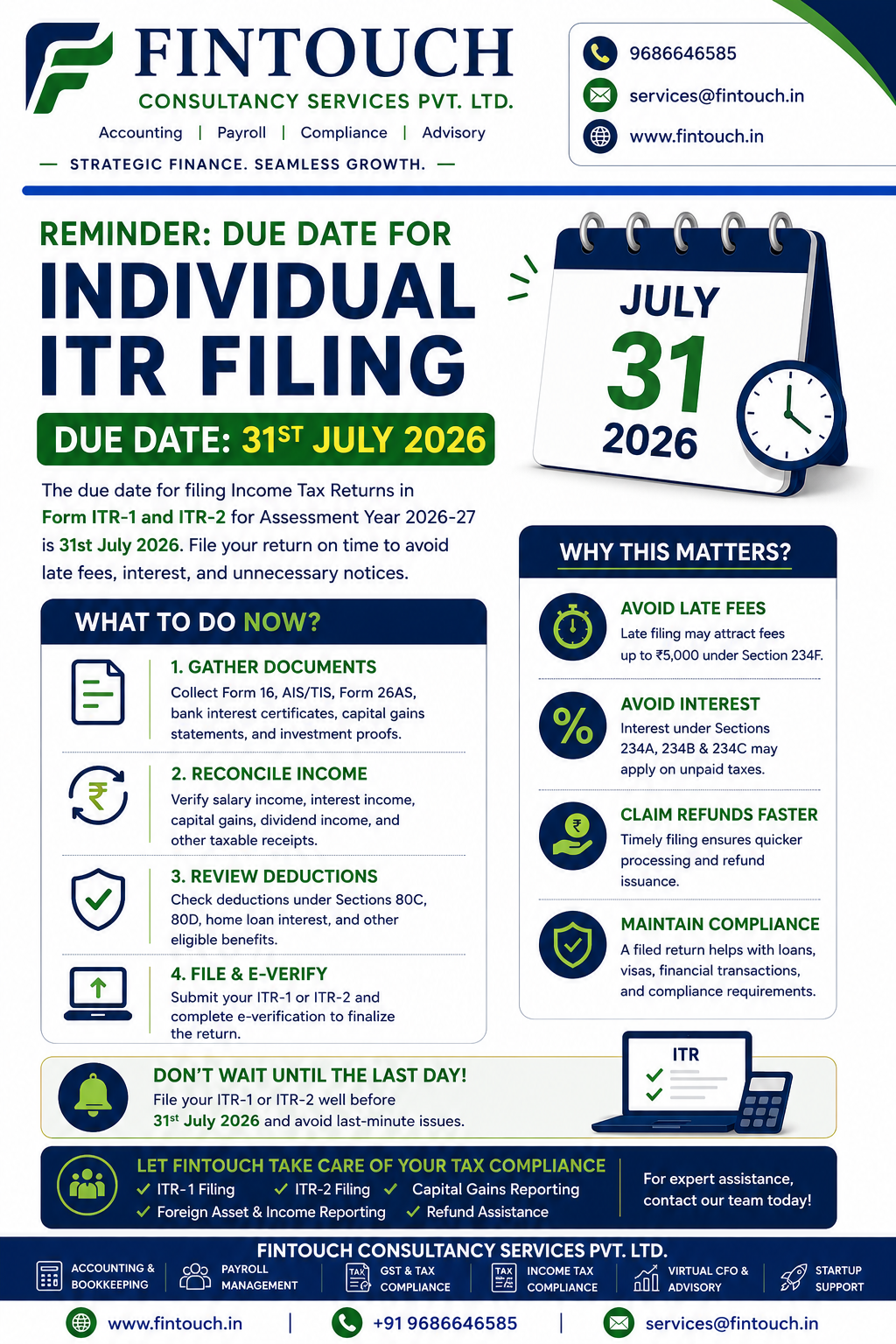
ITR filing for Assessment Year 2026-27 (Financial Year 2025-26) is officially open. The Income Tax Department has already enabled ITR-1 (Sahaj), ITR-2, and ITR-4 (Sugam) on the e-filing portal, with more forms expected in the coming weeks.

But before you file β€” or before you ask your CA to file β€” it is important to know what has changed from last year. Some of these updates directly affect which form you should be filing and what documents you need to keep ready.

Here is everything you need to know.


Forms Currently Available on the E-Filing Portal

As of June 2026, the following ITR forms are live at incometax.gov.in for AY 2026-27:

FormWho Should FileStatus
ITR-1 (Sahaj)Salaried individuals, pensioners β€” income up to β‚Ή50 lakhβœ… Live
ITR-2Capital gains, multiple house properties, foreign incomeβœ… Live
ITR-4 (Sugam)Presumptive income β€” sections 44AD, 44ADA, 44AEβœ… Live
ITR-3Business or professional income⏳ Coming Soon
ITR-5Firms, LLPs, AOPs⏳ Coming Soon
ITR-6Companies⏳ Coming Soon
ITR-7Trusts, institutions⏳ Coming Soon

Important Clarification Before We Begin

Even though the new Income Tax Act, 2025 came into force on 1 April 2026, your AY 2026-27 return covers income earned during FY 2025-26 β€” which falls under the Income Tax Act, 1961. CBDT has confirmed this. Deductions under sections 80C, 80D, 24(b), 80TTA, and the rebate under section 87A continue to apply as usual. Do not let the new Act cause any confusion while filing this year.


What Has Changed in Each Form β€” AY 2026-27 vs AY 2025-26

ITR-1 (Sahaj) β€” The Biggest Change This Year

Who files this: Salaried individuals, pensioners, and those with interest or rental income β€” total income up to β‚Ή50 lakh.

The most significant change in AY 2026-27 is for ITR-1 filers. In AY 2025-26, this form could only be used by taxpayers with income from one house property. From this year, ITR-1 now accommodates income from up to two house properties. This is a major relief β€” many taxpayers who were unnecessarily filing the more complex ITR-2 solely because of a second property can now switch back to the simpler ITR-1.

Other changes in ITR-1:

  • Tenant details now mandatory: If you earn rental income, you must now disclose the tenant’s name along with their PAN or Aadhaar number. This was not required in AY 2025-26.
  • Secondary contact details added: The form now captures a secondary mobile number, secondary email address, and an alternate address.
  • Representative assessee filing simplified: Filing on behalf of a deceased person or minor is now easier, with reduced disclosure requirements.
  • Section 89A removed: If you claim relief on income from a foreign retirement account, you can no longer do so through ITR-1. You will need to file ITR-2 or ITR-3 for this purpose.

ITR-2 β€” Simpler Capital Gains Reporting

Who files this: Individuals and HUFs with capital gains from shares, mutual funds or property; income from more than one house property; or foreign assets and income.

The most notable change in ITR-2 this year is the simplification of capital gains reporting. In AY 2025-26, taxpayers had to split their capital gains transactions as before and after 23 July 2024, because the tax rates changed on that date. Since those old rates (15% STCG and 10% LTCG) no longer apply for FY 2025-26, the corresponding fields have been entirely removed from the AY 2026-27 form.

Updated capital gains rates now applicable:

  • Short-term capital gains on equity (Section 111A): 20%
  • Long-term capital gains on equity (Section 112A): 12.5%

Other changes in ITR-2:

  • The July 23 date-split requirement for capital gains is gone entirely.
  • Secondary mobile, email and address fields now mandatory.
  • Tenant’s PAN or Aadhaar now required for rental income.
  • Section 89A field removed β€” foreign retirement account claims must use ITR-3 going forward.

If you sold equity mutual funds or listed shares during FY 2025-26, the capital gains schedule is considerably simpler this year. Keep your Consolidated Account Statement (CAS) from NSDL or CDSL and your broker’s capital gains statement ready before filing.


ITR-4 (Sugam) β€” More Disclosure Required

Who files this: Individuals, HUFs and firms (other than LLPs) opting for presumptive taxation under sections 44AD (business), 44ADA (professionals) or 44AE (transport operators) β€” income up to β‚Ή50 lakh.

While ITR-1 and ITR-2 have largely become simpler, ITR-4 requires more from filers this year.

Changes in ITR-4:

  • Investment and bank balance disclosure is now mandatory: This is a new requirement not present in AY 2025-26. Presumptive taxpayers must disclose investment details and bank balances in the return. Keep your FD certificates, mutual fund statements, and latest bank balance details ready.
  • Two house properties now permitted: Similar to ITR-1, ITR-4 now accommodates up to two house properties.
  • Tenant’s PAN or Aadhaar now required for rental income.
  • Secondary contact details now mandatory.
  • Section 89A field removed.

Changes Common Across All Forms

Regardless of which ITR form you file, the following changes apply uniformly in AY 2026-27:

  • Secondary contact details are mandatory β€” secondary mobile number, email address, and alternate address are now required fields, not optional.
  • Tenant’s PAN or Aadhaar is required for any rental income reported in house property schedule.
  • New tax regime selection is clearer β€” the process for opting in or out of the new tax regime has been streamlined, reducing the confusion around Form 10-IEA that many taxpayers faced last year.
  • Representative assessee filing is simplified across all forms for filing on behalf of deceased persons, minors, or legally incapacitated individuals.

Key Deadlines for AY 2026-27

ComplianceDue Date
Form 16 from employer15 June 2026
ITR filing β€” salaried, individuals, HUF (non-audit)31 July 2026
ITR filing β€” business/profession (non-audit)31 August 2026
ITR filing β€” audit cases31 October 2026
E-verification after filingWithin 30 days of filing
Belated return31 December 2026

Critical reminder: An ITR filed but not e-verified within 30 days of submission is treated as a defective return β€” legally the same as never having filed. Always complete e-verification immediately after submitting your return using Aadhaar OTP, net banking, or Demat account.


Quick Checklist Before You File

For all taxpayers:

  • PAN and Aadhaar (must be linked)
  • AIS and Form 26AS
  • Bank account details for refund
  • Secondary mobile and email
  • Tenant’s PAN or Aadhaar (if applicable)

For salaried individuals:

  • Form 16 (available from employer after 15 June)
  • Bank interest certificates
  • Home loan interest certificate
  • 80C investment proofs β€” PPF, ELSS, LIC, NSC

For capital gains filers:

  • CAS from NSDL or CDSL for mutual funds
  • Capital gains statement from broker
  • Property sale documents if applicable

For ITR-4 filers:

  • Turnover or receipts summary
  • Business bank statements
  • Investment details and bank balances (new this year)

Need Help Filing Your Return?

At Fintouch Consultancy Services Pvt. Ltd., we manage ITR filings for salaried individuals, business owners, professionals, companies and trusts. We ensure the correct form is selected, all new disclosures are captured, and your return is filed and verified well before the deadline β€” without any last-minute stress.

Get in touch with us today and let us handle your filing for AY 2026-27.


Disclaimer: This article is for general informational purposes only and does not constitute professional tax advice. Please consult a qualified tax professional for advice specific to your situation.

Business concept. Business people discussing the charts and graphs showing the results of their successful teamwork.

Step-by-Step Guide to Registering a Private Limited Company in India (2025 Update)

Introduction
Starting a business is an exciting journey, and registering a Private Limited Company (Pvt Ltd) is one of the most popular choices for startups and entrepreneurs in India. This blog walks you through the entire process, benefits, and key documents needed for a successful registration in 2025.

Why Choose a Private Limited Company?

  • Limited liability: Shareholders’ liability is limited to their shares.
  • Separate legal entity: The company exists independently of its owners.
  • Ease of fundraising: Preferred by investors and VCs.
  • Perpetual succession: The company continues to exist regardless of ownership changes.

Step-by-Step Registration Process:

  1. Digital Signature Certificate (DSC):
    Required for all proposed directors. You can get a DSC from a government-certified agency.
  2. Director Identification Number (DIN):
    Apply through the SPICe+ form along with the company registration.
  3. Name Approval via RUN or SPICe+:
    Choose a unique name that reflects your business and get it approved.
  4. Filing SPICe+ Form (Part A & B):
    This integrated web form covers:
    • Incorporation
    • DIN allotment
    • PAN & TAN
    • GST registration (optional)
    • EPFO & ESIC registration
  5. Submission of MOA & AOA:
    Draft and submit the Memorandum of Association and Articles of Association.
  6. Issuance of Certificate of Incorporation (COI):
    Once approved, the MCA will issue a COI, which includes the PAN and TAN.

Documents Required:

  • PAN and Aadhaar of directors
  • Address proof (bank statement/utility bill)
  • Passport-size photographs
  • Rental agreement (if office is on rent)
  • NOC from the property owner
  • Proof of business address

Timeline & Cost:
Typically takes 7–10 working days. Cost varies depending on professional fees and government charges.

Conclusion:
Registering a Pvt Ltd company in India is now faster and easier with online integration. Partner with an expert accounting firm to ensure a hassle-free and compliant registration process.

business man financial inspector and secretary making report, calculating or checking balance. Internal Revenue Service inspector checking document. Audit concept

7 Common Mistakes to Avoid When Registering Your Private Limited Company-2

Introduction
Registering a Private Limited Company might seem straightforward, but many startups make avoidable mistakes that can delay or even reject their applications. Here are 7 common pitfalls you should avoid during Pvt Ltd registration.

1. Choosing a Conflicting Company Name
Many applications get rejected due to similarities with existing trademarks or companies. Use the MCA name search tool and cross-check with the Trademark Registry before applying.

2. Incomplete Documentation
One missing document (like a signed NOC or rent agreement) can halt your entire registration. Always prepare a full checklist in advance.

3. Incorrect DIN or DSC Applications
Failing to validate identity properly while applying for DSC/DIN can cause unnecessary delays. Use authorized service providers to avoid errors.

4. Neglecting MOA & AOA Drafting
The Memorandum and Articles of Association define your business scope. Vague or inaccurate drafting can limit future operations or lead to rejections.

5. Ignoring Registered Office Compliance
Your company must have a physical registered office address with valid proof and NOC. Temporary or fake addresses can cause legal trouble.

6. Not Applying for GST When Needed
If your turnover is expected to cross the threshold or you operate in interstate trade, apply for GST during registration to save time.

7. DIY Registration Without Expert Help
While self-registration is possible, errors can be costly. An experienced accountant or CA ensures compliance and faster approvals.

Conclusion
Avoiding these common mistakes can save time, money, and effort. Consult a professional accounting firm to ensure a smooth and successful Pvt Ltd registration journey.